StillDeadcode

Whitepapers

Technical reports on the quantization formats built in Radiance, with their methods, measurements and results on Qwen3.8 27B.

IQR-V46 pages

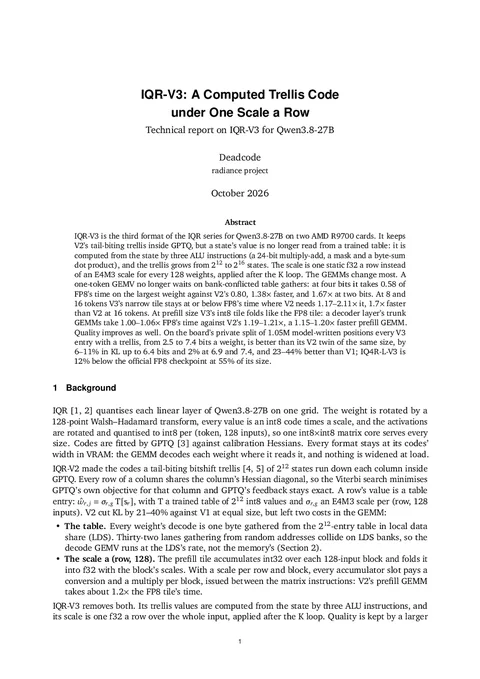
IQR-V4: Measured Widths, a Vocabulary-Weighted Head and Faster Kernels

V3's computed trellis with widths from measured prices, a bf16 block scale on the projections the attention heads feed, and an lm_head whose rows get their width by their token's probability. Every entry has 2–19% less KL than its V3 twin, and the kernels now decode a single stream faster than the MXFP4 checkpoint at five times lower KL.
Download PDF 70 KB
IQR-V310 pages

IQR-V3: A Computed Trellis Code under One Scale a Row

V2's trellis with its values computed from the state by three ALU instructions instead of read from a table, and one f32 scale a row instead of one every 128 weights. Against IQR-V2 at the same size it has up to 11% less KL, a 1.15–1.20× faster prefill GEMM and a one-token GEMV up to 1.67× faster; IQ4R-L-V3 is below the official FP8 checkpoint at 55% of its size.

Download PDF 284 KB
IQR-V27 pages

IQR-V2: Trellis-Coded GPTQ Columns on a Rotated Int8 Grid

A tail-biting bitshift trellis run down each column of the rotated weight inside GPTQ, where its Viterbi search minimises GPTQ's own per-column objective. Against IQR-V1 at the same size it has 21–40% less KL; IQ4R-L-V2 is below the official FP8 checkpoint at 55% of its size.

Download PDF 293 KB
IQR-V17 pages

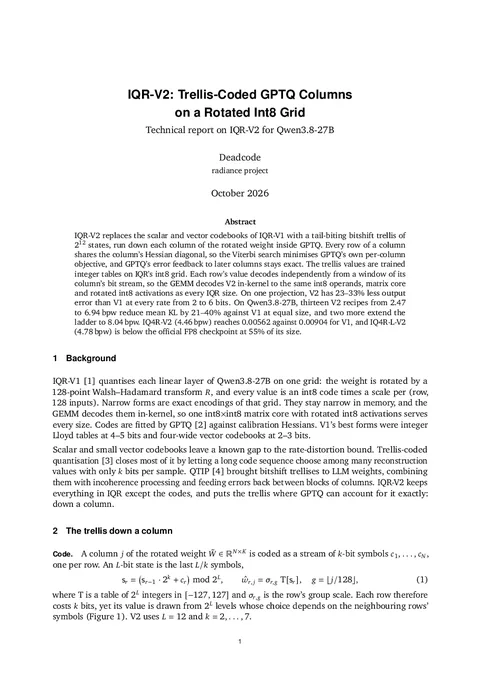
IQR: GPTQ Integer Quantisation on a Rotated Int8 Grid

Every format from two to eight bits is an exact encoding of one rotated int8 grid: the weights stay narrow in memory, and the GEMM decodes them onto one int8 matrix core. GPTQ with codebook grids and a band-sensitivity allocator beats the dynamic GGUF quants at every size from 2.5 to 7.4 bits per weight.

Download PDF 289 KB